Barber Booking System: Stopping No-Shows With Deposits
How a barber booking system cuts no-shows: deposits or prepayment at booking, a clear cancellation policy, reminders, and a quick way to rebook the chair.
 The Fluent team7 min read
Nesta página
- Why do no-shows hurt a barbershop so much?
- What should a barber booking system do about no-shows?
- How much deposit should you take?
- How do you write a no-show policy clients accept?
- How do reminders and rebooking fill the gap?
- What should you look for in barbershop software?
- How does Fluent Booking handle bookings, payments and client history?
- Frequently asked questions
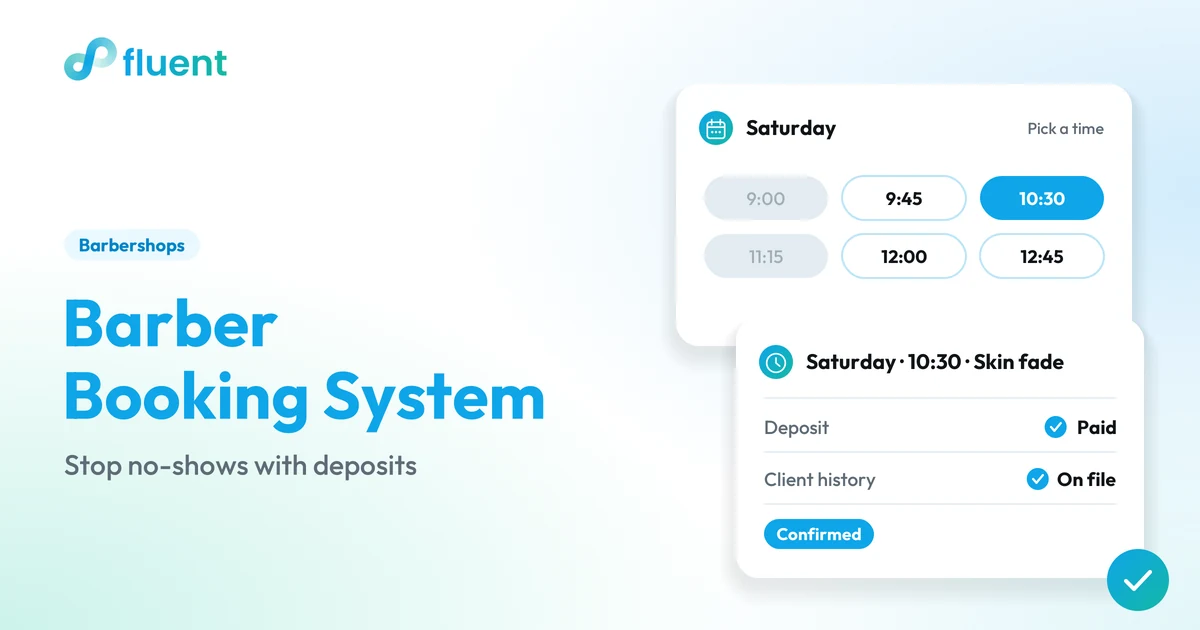
A barber booking system cuts no-shows in three moves: it takes a deposit or prepayment when the client books, shows your cancellation policy before they confirm, and reminds them before the appointment. The deposit matters most. A client with money down treats the chair as theirs, so they show up or cancel in time for you to refill it.
Key takeaways
- A no-show costs you the cut, the tip, the add-ons and sometimes a walk-in you turned away.
- A deposit at booking is the strongest fix, because money down changes how a client treats the slot.
- Keep the deposit simple, take it off the final price, and say plainly when you keep it.
- A short policy, a reminder and a fast way to refill the chair cover what a deposit misses.
- Fluent Booking can take a deposit or the full price when a client books; availability depends on your country and setup.
Why do no-shows hurt a barbershop so much?
Because a barber's time can't sit on a shelf. A 2 p.m. slot nobody fills is gone at 2:45. And a no-show costs more than the cut: the tip, the beard lineup they'd have added, the pomade at the counter, and often the walk-in you sent away because the book said you were full.
Here's an illustrative example, not data from a real shop. A three-chair shop charges $35 a cut, and each barber gets two no-shows a week. That's six empty slots and $210 a week in services alone, or $10,920 a year, before tips and add-ons.
It stings most on a Saturday, and it wears on the barber who came in early for nobody. Run your own numbers below.
No-show calculator
Illustrative estimateWhat no-shows cost you
- Lost per week
- $105
- Per month
- $452
- Per year
- $5,460
Illustrative estimate: a month counts as 4.3 weeks, a year as 52. Rebooked slots and deposits lower the real figure.
What should a barber booking system do about no-shows?
It should make showing up the expected thing and make not showing up cost something. That means five jobs:
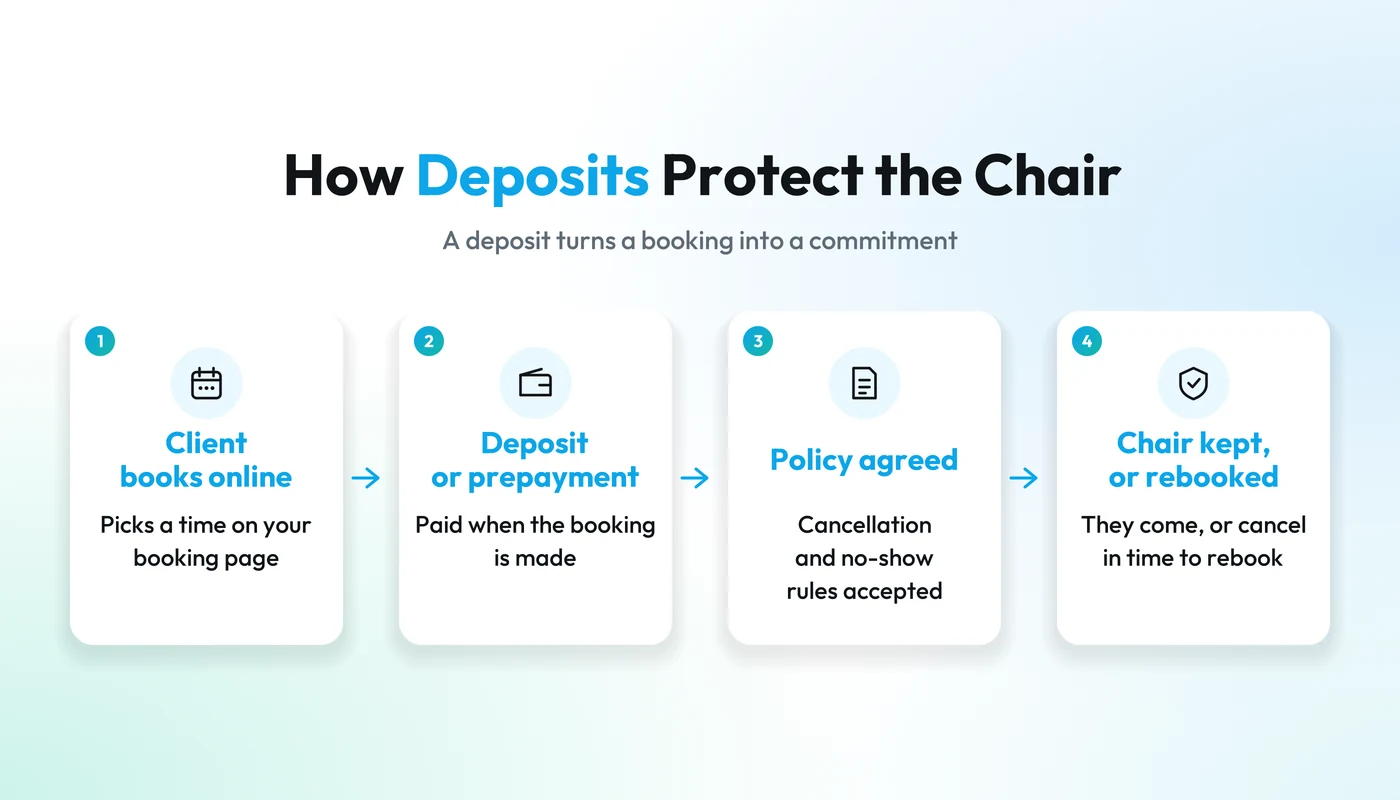
- Take money down at booking: a deposit or full prepayment.
- Show the policy before the client confirms, not after they miss.
- Remind the client, with an easy way to cancel or move.
- Help you refill the slot when someone cancels.
- Keep each client's history, so you know who's reliable.
The deposit comes first for a reason. A reminder catches the client who forgot. It does nothing for the client who booked two shops for Saturday and picks one that morning. Money down does.
How much deposit should you take?
Enough that losing it stings, little enough that a real client doesn't think twice, and always credited to the final bill. What you'll end up with: one simple rule, plus a stricter one for the slots that hurt most to lose. The amounts below are illustrative.
| Option | Illustrative amount | Best for | Watch out for |
|---|---|---|---|
| Flat deposit | $10 per booking | Mostly standard cuts | Small next to long services |
| Percentage | 25% to 50% of the service | Mixed menus: cuts, beards, color | Explain the math clearly |
| Full prepayment | The whole service | New clients, Saturday slots, long services | More friction for first-timers |
| No deposit | $0 | Regulars with a clean record | Runs on goodwill alone |
Before you start, check what your payment setup supports in your country. Then:
- Set one rule for every new client, such as a flat deposit.
- Ask for more on the slots you can least afford to lose: Saturday mornings, after-work hours, long services.
- Take it off the price at checkout, so it never feels like a fee.
- Review after a month. If a slot keeps going empty, move it to full prepayment.
How do you write a no-show policy clients accept?
Keep it short, fair and visible before the client books. People accept a rule they saw up front and resent one they discover later. What you'll end up with: a barber no-show policy short enough for your booking page, your confirmations and a sign by the register.
Before you start, have two numbers ready: your deposit and how much notice you need to refill a chair.
- Set a cancellation window you can refill. If a day's notice lets you fill the chair from your waitlist or walk-ins, 24 hours is fair.
- Say what happens to the deposit when a client cancels in time, cancels late or doesn't show.
- Set a late rule. Fifteen minutes late on a 30-minute fade is half the appointment, so decide when late counts as a no-show.
- Show it before the client confirms, then repeat it in the confirmation and the reminder.
- Apply it the same way every time, with one exception you stick to, like a regular's first real emergency.
A sample to copy (the numbers are examples):
Our booking policy. We hold your chair just for you, so we take a $10 deposit when you book. It comes off your service price. Need to cancel or move? Tell us at least 24 hours ahead and we'll move your deposit to the new time or refund it. Cancel later or don't show, and the deposit covers the empty chair. More than 15 minutes late? We'll do what we can in the time left or rebook you, and the deposit stays. Thanks for respecting your barber's time.
Practical tip
Read your policy out loud to a regular. If it sounds like a parking ticket, rewrite it until it sounds like you.
How do reminders and rebooking fill the gap?
Reminders catch the clients who forgot, and fast rebooking turns a late cancellation into a kept slot. Together they cover what a deposit can't: the honest mix-up, and the 9 a.m. text canceling an 11 o'clock. What you'll end up with: a routine for every gap.
- Remind clients the day before with the time, the barber, the one-line policy and an easy way to cancel or move.
- Make moving easier than ghosting. A client who can reschedule in a minute has no reason to vanish.
- Keep a short waitlist of regulars who'd take an earlier slot, and message them when a chair opens, if they've agreed to hear from you.
- Leave room for walk-ins on busy days, so a Saturday gap fills itself.
- Follow up after a no-show with a friendly offer to rebook, deposit included.
What should you look for in barbershop software?
Look for barbershop software that handles the whole appointment, from booking to payment to the next visit, so a no-show is something you can see, charge for and follow up on in one place. Use this checklist when you compare tools.
| Look for | Why it matters | Ask in the demo |
|---|---|---|
| Online booking for barbers | Clients book without calling | What does the client see before they confirm? |
| Deposits or prepayment | Money down is the strongest fix | Does it work with my payment provider in my country? |
| A visible policy | Clients accept rules they saw up front | Where does my policy show during booking? |
| Reminders and follow-ups | Catches clients who forgot | What goes out automatically today, and what's coming? |
| Client history | Shows who's reliable | Can I see a client's past visits when they book? |
How does Fluent Booking handle bookings, payments and client history?
Fluent Booking keeps appointments, availability, customers and payments in one place. Clients request a time from your online booking page, and you accept, decline or propose another time. The client gets an email each time the booking changes.
When a client books, you can take a deposit or the full price through Fluent's payment partners, such as Stripe and SumUp. Availability depends on your country and setup, so check yours when you book a demo.
Because you answer each request, you decide who gets your Saturday 10 a.m. Each client's history sits with the appointment, so you see who's asking before you say yes. Share your policy in the confirmation you send and wherever clients find you: your website, your social profile and the sign by the register.
At checkout, clients can add a tip, and you see sales and tips for each barber. Automatic reminders are coming to Fluent Booking soon. Today, Fluent's tools for payments, email and SMS, gift cards and loyalty cover the rest of the routine: Email & SMS follow-ups for clients who've agreed to hear from you, loyalty rewards and gift cards for your regulars, and Shifts for your barbers' schedules.
See everything Fluent does for barbers on our barbershop software page.
FLUENT BOOKING
Keep every chair busy: see Fluent Booking in a 15-minute demo
Marcações, disponibilidade, clientes e pagamentos no mesmo negócio. Concentre-se na pessoa à sua frente.
Frequently asked questions
Will a barbershop deposit scare off new clients?
Some first-timers will hesitate, and that's partly the point: a deposit filters out bookings that were never going to show. Keep it small, take it off the final price and explain it in one friendly line. Framed as "$10 down, comes off your cut," it reads like a busy shop, not a penalty.
Should regulars pay a deposit too?
That's your call, but decide once and write it down. A simple approach: regulars with a clean record skip it, while new clients and prime slots like Saturday mornings pay one. If a regular starts missing appointments, move them back to a deposit and tell them why in person.
What should you do when a client no-shows anyway?
Follow your policy: keep the deposit and send a short, friendly message offering to rebook. Don't argue over text. Note the missed appointment so you remember it next time, and after a second no-show, ask for full prepayment on future bookings. A client who values your chair will understand.
Does a barber appointment app work for a shop that takes walk-ins?
Yes. Block the hours you want for appointments and keep the rest for walk-ins, or make one chair walk-in only. The two help each other: a walk-in fills the gap when an appointment cancels late or doesn't show, and booked appointments keep the slow hours from sitting empty.