AI for Small Business Marketing: What Actually Works in 2026
Where AI helps small business marketing in 2026: choosing who to contact from your customer data, drafting the message, timing it, and measuring visits.
 The Fluent team10 min read
In questa pagina
- What does AI actually do well for small business marketing?
- Which marketing jobs should you hand to AI first?
- Where does AI marketing go wrong?
- What customer data do you need before AI marketing works?
- How do you know if it worked?
- What does a 30-day plan to start look like?
- How does Fluent connect marketing to your daily data?
- Frequently asked questions
AI for small business marketing earns its keep on three jobs: picking who to contact from your own customer history, drafting the message, and choosing when to send it. It is weak at churning out mass content. Keep consent and the final yes with you, and judge results by visits and sales, not opens.
Key takeaways
- Marketing AI that works starts from your own records (who came in, what they bought, who stopped coming), not from a pile of new content.
- Let AI build the list and write the first draft; the decision to send stays with you.
- Start with one job your data already points to, such as winning back regulars who have gone quiet.
- Contact only customers who opted in, and follow the email and SMS marketing rules where you operate.
- Count the visits and sales that follow a message, not how many people opened it.
What does AI actually do well for small business marketing?
AI does well at the parts of marketing that are really sorting and writing: finding the right people in your customer history, drafting a short message for them, and suggesting when to send it. It does poorly at the part that gets the most attention: producing more content.
Most local businesses don't have a reach problem. They have a memory problem. The customer who came in for a latte every weekday, the client who booked a cut every four weeks, the family who ordered every Friday: when one of them drifts away, nobody notices for months. Spotting that drift is tedious pattern-finding, which is exactly what AI is good at.
| Marketing job | What AI does well | What stays with you |
|---|---|---|
| Choosing who to contact | Sorts customers by last visit, how often they come and what they buy | Checking that the list makes sense |
| Drafting the message | Writes a short first draft for that group, in the tone you give it | Editing it and saying yes |
| Timing | Suggests a day, based on when that group usually comes in | Choosing the send time and any offer |
| Mass content | Produces a lot of generic text quickly | Deciding whether to post at all |
Generic posts written by AI sound like everyone else's, and customers can tell. One line such as "We haven't seen you since spring. Thursday mornings are nice and quiet if you want to come by for your usual" (illustrative) does more for a café than ten posts about fresh flavors.
So the rule for this guide is simple. AI marketing for small business works when it starts from your own customer data. Let AI pick who to contact and draft the message. You approve it, and you measure visits and sales.
Which marketing jobs should you hand to AI first?
Hand AI the jobs where your own data already names the right customers and the result shows up as a visit or a sale you can count. Six jobs fit that description for most cafés, shops, barbers and restaurants. Pick one to start, not all six.
Marketing is one slice of the work worth handing over; our guide to AI workflow automation for small business covers the rest, such as staff schedules and supplier orders.
Win back lapsed customers
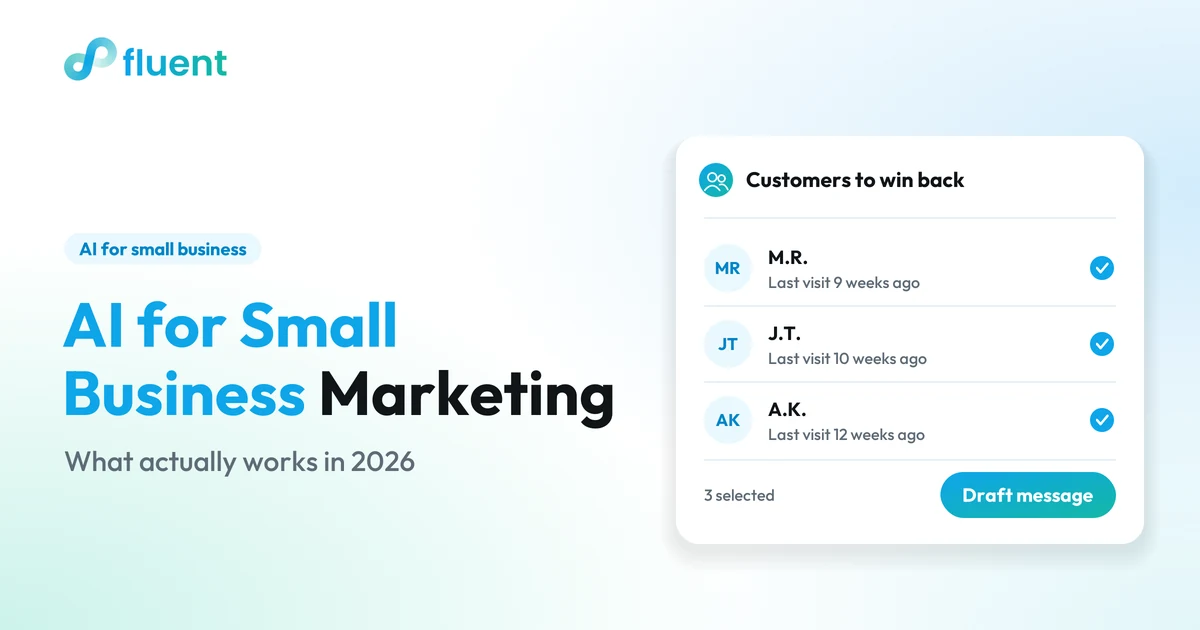
A customer win-back campaign goes to people who used to come regularly and have stopped. It is the best first job: the list comes straight from your history, and the goal is one more visit.
AI compares the time since each customer's last visit with their normal gap and flags the ones well past it. In an illustrative barbershop, that is a client who booked every four weeks and hasn't been in for ten. AI then drafts a short, personal note with no hard sell. You read it, change whatever doesn't sound like you, and approve it.
Fill quiet days and slots
Every business has dead hours: the Tuesday lunch, the empty chair on Wednesday afternoon. AI can find customers whose habits suggest they could fill that time, such as people who often come in on weekdays or book at short notice, and draft an invitation.
Keep the group small and the reason specific. If everyone on your list gets a quiet-day deal every week, they learn to wait for it.
Nudge loyalty members
A loyalty program hands you two useful lists: members who are close to a reward, and members who have stopped using it. AI can spot both and draft a nudge, such as "You're one coffee away from a free one" (illustrative). These messages work because they are about something the customer already has, so they rarely need a discount on top.
Seasonal gift card pushes
Gift cards sell around holidays, and the likeliest buyers are the people who bought last year. AI can pull last season's buyers and your most loyal customers, then draft a short reminder a few weeks ahead. An illustrative bakery might message last December's gift card buyers in late November. The list is short, the reason is obvious, and every card sold shows up in your sales.
Reply to reviews
Reviews need answers, and a good reply takes time you don't have at nine at night. AI can draft a reply that thanks the person, mentions what they actually wrote and, for a complaint, offers a way to make it right. Read every reply before it goes out. It is public, and it should sound like the owner, not a template.
Turn what is happening in the business into social posts
This is the one content job worth handing over, because the material is real. A new seasonal dish, a delivery of spring stock, a batch that sold out by ten, a new barber on the team: AI can turn a fact from your week into a short post in your voice. What it should not do is invent things to say. If nothing happened this week, skip the post.
Where does AI marketing go wrong?
AI marketing goes wrong when it sends more messages to more people with less thought. Most failures come down to six mistakes.
Contacting people who never opted in. Contact only customers who agreed to hear from you, and follow the email and SMS marketing rules where you operate. A tool that makes sending easy does not change who you may contact.
Letting it send without you. A draft can get a name, a day or an offer wrong. Keep approval as a step every time, even after ten good drafts.
Mass content. Posts that could belong to any business add noise and give nobody a reason to come in.
Discounting people who were coming anyway. Point a discount at your most loyal customers and you pay for visits you would have had for free. Save offers for lapsed customers and quiet slots.
Sending too often. When everything is a campaign, people stop reading and start unsubscribing.
Measuring opens. An open tells you the subject line worked. It does not tell you whether anyone walked through the door.
What customer data do you need before AI marketing works?
You need three things for each customer: a way to reach them, a record that they agreed to be contacted, and a dated history of their visits or purchases. Without the history, AI has nothing to sort. Without the permission, you have nobody to send to.
| Data | Why AI needs it | Where it usually comes from |
|---|---|---|
| Name and email or mobile number | To send the message | Bookings, online orders, loyalty sign-ups |
| Marketing opt-in | To know who you may contact | The moment someone signs up or books |
| Visit dates and what they bought or booked | To spot who has lapsed and make the message relevant | Your counter, booking or order system |
| Loyalty and gift card activity | To find members near a reward and last season's buyers | Your loyalty and gift card records |
The most common gap is anonymous sales. If most customers pay at the counter and leave, you have sales numbers, not a customer history. A loyalty program is the usual fix, because it gives people a reason to tell you who they are. Appointment businesses start ahead, since every booking already carries a name.
The second gap is scattered data. When bookings, sales and email addresses live in different places, AI only sees the piece in front of it.
Practical tip
Before you ask AI for any list, write down what "lapsed" means for your business. For a café it might be three weeks without a visit; for a barbershop, twice a client's usual gap between cuts (both illustrative).
How do you know if it worked?
A campaign worked if the people you contacted came back and spent more than it cost you to bring them back. Count visits and sales from the people you messaged, compare them with a similar group you didn't message, and ignore open rates.
The comparison matters because some of those customers would have come back anyway. Take an illustrative case. You message 40 lapsed regulars and hold back 20 who look just like them. Over the next three weeks, 10 of the 40 come back, and 2 of the 20 do. At the held-back group's rate, about 4 of your 40 would have returned without a message, so the campaign brought back roughly 6 people. Add up what those 6 spent, subtract the cost of any offer, and you have the number that matters.
Track three things for every campaign:
- Return visits from the people you messaged, within a set window such as three weeks
- Sales from those visits, minus any discount you gave
- Replies and unsubscribes, which tell you whether the tone landed
What does a 30-day plan to start look like?
Pick one job, run it properly for a month, and measure it before you add another. This plan uses a win-back campaign because it is the easiest to set up and count.
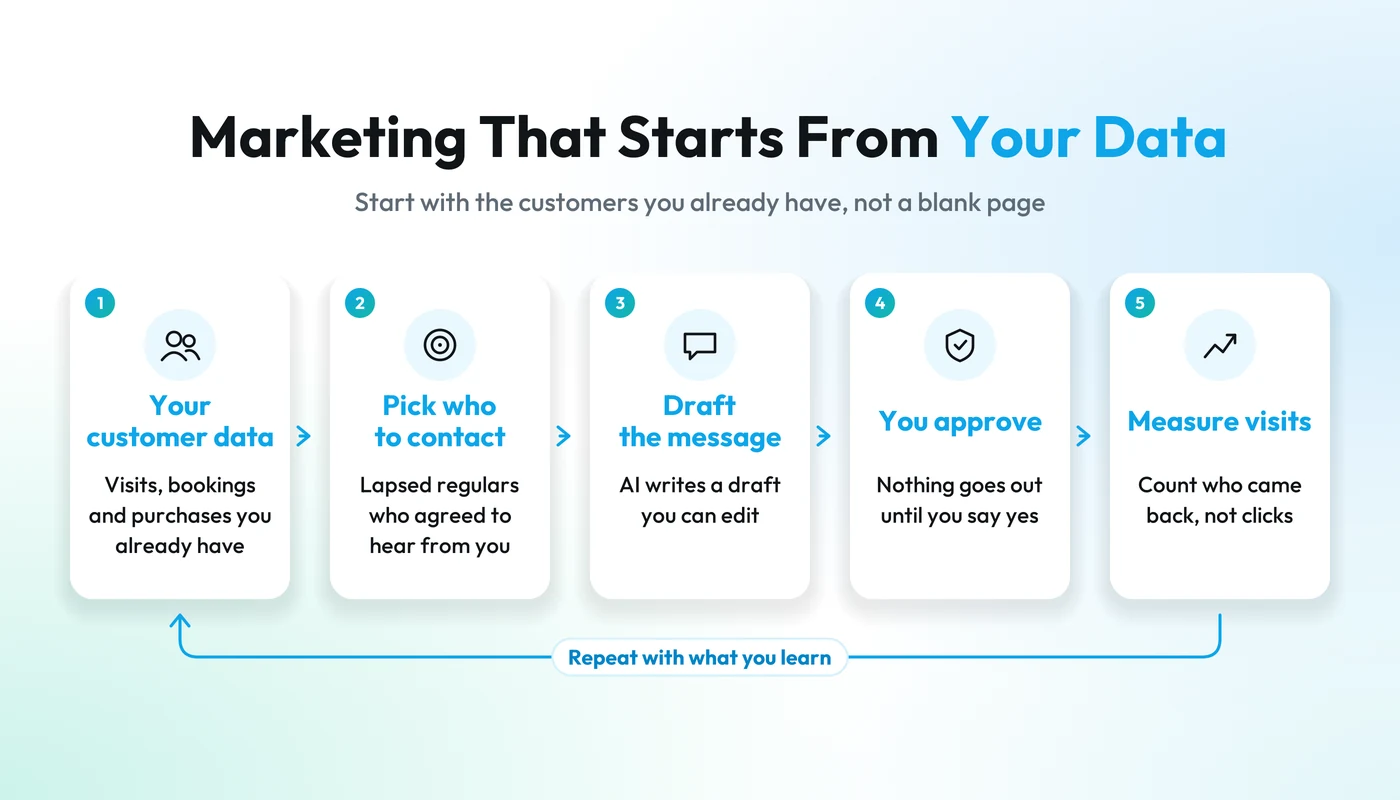
- Days 1 to 3: Check your list. Find which customers have opted in and have a working email address or mobile number. Merge duplicates.
- Days 4 and 5: Define "lapsed." Choose the gap that means a customer has drifted away.
- Week 2: Build the list. Ask AI for the customers who fit, read the reasons it gives, and remove anyone who shouldn't be there, such as someone who complained last week.
- Week 2: Draft and hold back. Have AI write the message, then edit it until it sounds like you. Set aside a handful of similar customers who won't get it.
- Week 2: Approve and send. Pick a time that suits the group, for example a few days before a quiet day you want to fill.
- Week 3: Answer replies. Let AI draft the answers if it helps, and send them yourself.
- Week 4: Count. Compare visits and sales between the two groups. Then repeat the campaign, change the message, or move to the next job, such as filling a quiet day.
How does Fluent connect marketing to your daily data?
Fluent runs the daily work of a local business in one system, so the orders, payments and bookings that marketing depends on build up in one place as you work. Fluent AI sits across that system: you ask about your business in plain words, and it is designed around the orders, payments, bookings, stock and team information already in Fluent.
So you can ask the questions from this guide directly. Fluent AI can list the regulars who used to come often and have gone quiet, sorted by how much they matter to the business, and the new customers who haven't been back for a second visit. It shows how it picked each one and can write a first draft of the message for you to edit. Nothing is sent or changed until you approve it.
The tools that send the message sit in the same place. The Fluent tools include Email & SMS for campaigns and follow-ups to customers you have permission to contact, Loyalty & rewards, and Gift cards, alongside payments, shifts and invoicing. You review the list, edit the draft and send it from Email & SMS yourself.
Some AI workflows are still being added, so confirm which ones fit your business in a demo.
When the month is up, each customer's visits and spend are already in Fluent, so you can check the people you messaged and the ones you held back, or ask Fluent AI for any customer's full history.
FLUENT AI
See which of your customers are worth bringing back, in a 15-minute Fluent demo
Chiedi della tua attività, esplora i dati e prepara il prossimo passo. Un assistente utile per le decisioni e il lavoro di ogni giorno.
Frequently asked questions
What should I look for in AI marketing tools for small business?
Look for a tool that works from your own customer and sales history, not a blank text box. It should show why it picked each customer, draft messages instead of sending them on its own, and wait for your approval. It should also help you contact only customers who opted in and count return visits afterward.
Does small business email marketing still work?
Yes, when the email is short, personal and sent for a reason. A note to a regular who hasn't been in lately, a nudge to loyalty members near a reward, or a gift card reminder before the holidays gives people a reason to visit. Newsletters with nothing to say get ignored. Send only to customers who opted in.
Will AI-written messages sound robotic to my regulars?
They will if you send the first draft untouched. Tell the AI how you talk, keep messages short, and edit each draft until it sounds like something you would say across the counter. Mention something specific, such as a customer's usual order, and cut any line that reads like an ad. You stay the final editor.
How often should a small business message its customers?
Only as often as you have a real reason. A win-back note, a quiet-day invitation and a seasonal gift card reminder are each a reason; a message because another week has passed is not. Watch replies and unsubscribes after every send, and if unsubscribes start to climb, slow down and make each message more specific.