How to reduce food waste in a small restaurant: a weekly routine
A weekly stock and prep routine for small restaurants and cafés: log waste, count stock, forecast covers and prep to par, so you throw away less food.
 The Fluent team8 min read
Sur cette page
- Where does food waste in a small restaurant come from?
- Step 1: Start a waste log before you change anything
- Step 2: Count stock once a week, and risky items every day
- Step 3: Forecast covers for each service
- Step 4: Turn covers into a prep list with par levels
- Step 5: Order to par, not to habit
- Step 6: Store and rotate so nothing gets forgotten
- Step 7: Review the week and change one thing
- The weekly routine at a glance
- How a connected system makes the routine easier
- Frequently asked questions
The most reliable way to reduce food waste in a small restaurant is to stop prepping and ordering from habit and start working from a few simple numbers: what you have, how many covers (guests) you expect, and what actually got thrown away. A short weekly routine (log waste, count stock, forecast covers, prep to par, order to par) is enough to show where the waste comes from and to cut it service by service. This guide walks through each step with worked examples you can copy into a notebook or spreadsheet today.
Key takeaways
- In many small kitchens, much of the avoidable waste comes from over-prep, over-ordering and forgotten stock rather than from guests' plates.
- Log everything you throw away, with a reason, for two weeks before you change anything.
- Forecast covers per service from the last four same weekdays, then adjust for bookings, weather and local events.
- Turn covers into a prep list with par levels: expected portions plus a small buffer, minus what is already prepped.
- Order to par, not to habit, and review the waste log once a week.
Where does food waste in a small restaurant come from?
Before you change anything, it helps to know which kind of waste you have. In most small kitchens it falls into five buckets:
- Over-prep: mise en place prepared for a busier service than the one you had. Cut salad, cooked rice, portioned fish and sauces that don't keep are typical.
- Over-ordering: buying by habit or by case size, so perishables arrive faster than you use them.
- Spoilage in storage: items pushed to the back of the fridge, poor rotation, missing labels.
- Plate waste: portions that are too big, or sides and garnishes that guests regularly leave.
- Mistakes and returns: wrong orders, burnt batches, dishes sent back.
The first three are planning problems. They are usually the ones you can fix fastest, because they depend on decisions you make before service starts. Plate waste matters too, but it is a menu and portion question you can tackle once the planning is under control.
Step 1: Start a waste log before you change anything
You can't reduce what you can't see. For the next two weeks, write down everything that goes in the bin or comes off the menu unsold, apart from peelings and bones you never planned to use. Keep a clipboard or tablet next to the bin and make it a two-second job.
Log five things:
| Day | Item | Quantity | Reason | Service |
|---|---|---|---|---|
| Tue | Risotto base | 1.5 kg | Over-prep | Lunch |
| Tue | Burrata | 4 pieces | Past use-by date | – |
| Wed | Cut salad mix | 2 trays | Over-prep | Dinner |
| Thu | Fries | 3 portions | Wrong order | Dinner |
Example rows only.
Keep the reasons to a short, fixed list (over-prep, spoiled or expired, plate waste, mistake) so you can count them at the end of the week. After two weeks a pattern usually appears: the same handful of items, on the same days, for the same reason.
Practical tip
Log in the unit you already work in: portions, kg, trays or pieces. Putting a price on it can wait until the weekly review; during service, speed matters more than precision.
Step 2: Count stock once a week, and risky items every day
A full stock count on a fixed day, before your main delivery, gives you a reliable starting point. Count everything you order regularly, in the same units your supplier uses.
Then pick your high-risk items: the ones that are expensive, spoil quickly, or both. Fresh fish, dairy, soft cheese, cut herbs, salad leaves, cooked sauces and stocks are the usual suspects. Count those every day before you write the prep list. It takes a few minutes and stops you prepping a fresh batch while yesterday's is still in the fridge.
Step 3: Forecast covers for each service
Prep should follow the number of guests you expect, not the number you had on your best day. A simple forecast is good enough:
- Take the covers from the last four same weekdays (the last four Fridays for a Friday).
- Average them.
- Adjust for what you already know: bookings, the weather if you have a terrace, school holidays, local events, a big match on TV.
Worked example. Say your last four Friday dinners had 82, 90, 78 and 86 covers. The average is 84. This Friday rain is forecast and the terrace will be closed; on past rainy Fridays that cost you about a dozen covers, so you plan for 72. If a concert nearby usually brings walk-ins, you would adjust the other way.
Write the forecast at the top of the prep list, and the actual covers next to it after service. If the forecast keeps coming out too high or too low, correct it in that direction next time.
Step 4: Turn covers into a prep list with par levels
A par level is the quantity of an item you want ready for a service. You prep the difference between the par and what you already have that is still good.
To set a prep par for a dish:
- Expected portions = forecast covers × the share of guests who order the dish. Your till or sales report gives you that share.
- Add a small buffer for uncertainty. Make it larger for items you can't finish quickly during service.
- Subtract what is already prepped and still within its shelf life.
Worked example. For 72 covers, if roughly 1 in 6 guests orders the risotto, you expect about 12 portions. Add a buffer of 2 portions for a par of 14. There are 4 portions of base left from lunch that are still fine, so tonight you prep 10.
| Item | Expected | Buffer | Par | Already prepped | To prep |
|---|---|---|---|---|---|
| Risotto base (portions) | 12 | 2 | 14 | 4 | 10 |
| Cut salad (trays) | 3 | 1 | 4 | 1 | 3 |
| Portioned fish | 9 | 1 | 10 | 0 | 10 |
Example figures for a 72-cover Friday dinner.
Two habits make par levels work better:
- Prep in two waves. Prepare most of what you need before service, and keep the last part for items you can finish quickly if it gets busy. If it gets busy you top up; if it doesn't, nothing extra ends up in the bin.
- Review pars when the menu changes. A new dish shifts the sales mix of the others, especially the ones that share ingredients with it.
Step 5: Order to par, not to habit
The same logic works for ordering. For each perishable item, set a par for the days until the next delivery, then order the difference:
Order quantity = par until next delivery − stock on hand − stock already on order
Worked example. You use about 3 kg of tomatoes a day and get deliveries every three days. That's 9 kg to cover the gap, plus a 2 kg buffer: a par of 11 kg. Your daily count shows 5 kg and nothing is on order, so you order 6 kg, not the usual 10 kg box.
If pack sizes force you to buy more than you need, ask your supplier about smaller packs or more frequent deliveries for the items that spoil fastest. It costs nothing to ask, and for the fastest-spoiling items it can make a real difference.
Step 6: Store and rotate so nothing gets forgotten
Planning only pays off if what you bought gets used in time.
- First in, first out: new deliveries go behind older stock, every time.
- Label everything you prep with the item and the date, and follow your local food safety rules on labelling and storage.
- Keep a "use first" shelf in the fridge for anything close to its date. Check it before you write the prep list and before you plan specials.
- Check fridge temperatures as part of opening, so a fault doesn't take a whole shelf with it.
Step 7: Review the week and change one thing
Once a week, ideally on the day of your stock count, spend 20 minutes with the waste log:
- List the three items that cost you the most (quantity thrown away × unit cost).
- Read the reasons. Over-prep means lowering the par or moving more prep into the second wave. Spoilage means ordering less, more often, or fixing rotation. Plate waste means looking at the portion or the garnish.
- Change one or two things, not ten, and watch the next week's log.
Use trim and surplus on purpose: staff meals, soups, sauces and a daily special built around what needs using. Where local rules allow, some restaurants also pass surplus food to food-sharing schemes. But the cheapest food waste is still the batch you never prepped.
The weekly routine at a glance
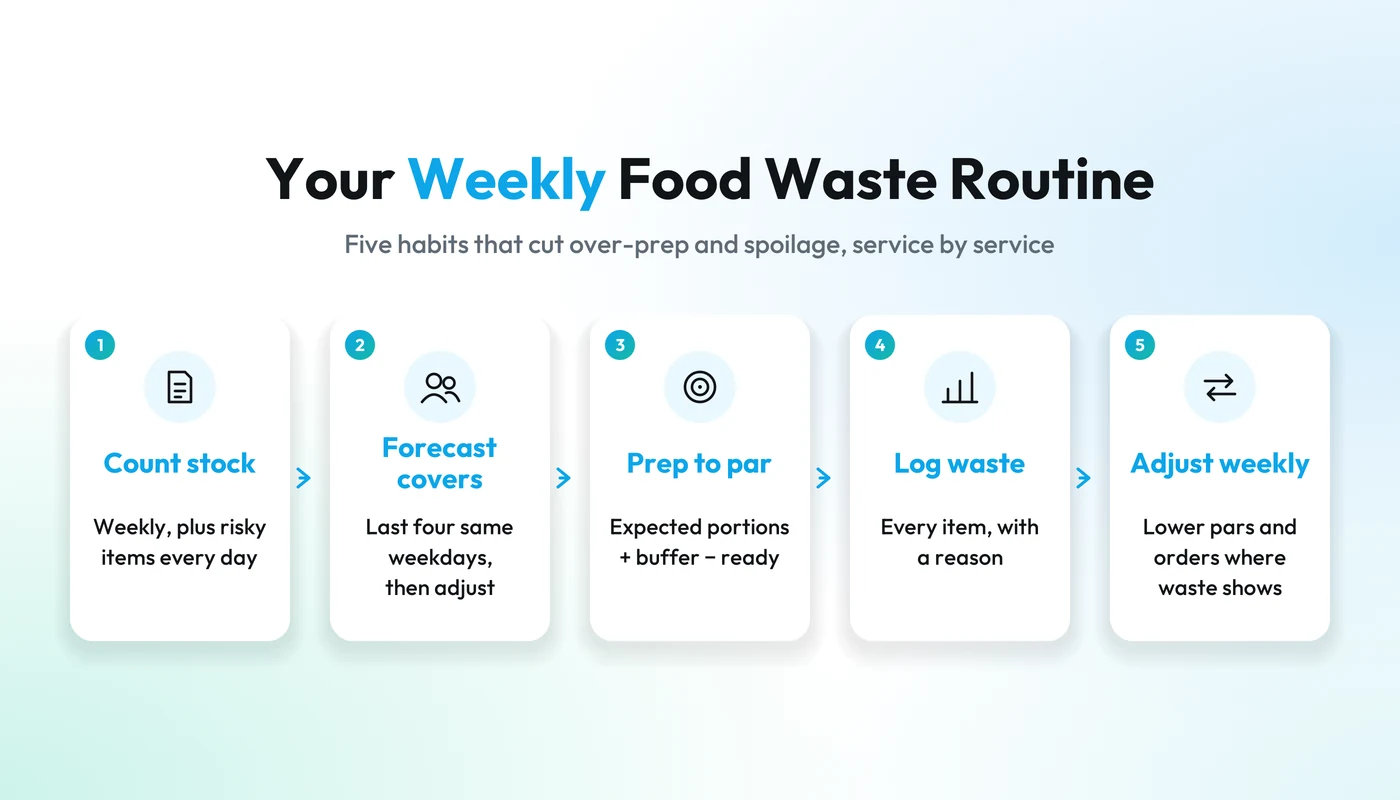
- Every day: count high-risk items, check the forecast, write the prep list from your pars, log waste with a reason.
- Once a week: full stock count before the main delivery, review the waste log, adjust pars and orders.
- When the menu changes: reset the pars for every dish that shares ingredients with the new one.
How a connected system makes the routine easier
Most of this routine is copying numbers from one place to another: covers from the booking book, the sales mix from the till, stock from a count sheet. When those live in one system, the numbers are already there when you sit down to write the prep list. (To count how often that copying happens in your week, try the handoff test.) In Fluent Restaurant, orders, payments and stock information stay connected, so the same sale doesn't need to be entered twice, and sales and ingredient information sit in the same view before the next service. Fluent AI answers the questions this routine asks every week: which dishes sell best, when you're busiest, what will run out within about a week at the current pace and what hasn't sold in 30 days, each with the figures behind it. It's also designed to add outside context, such as the weather and local events, and to prepare drafts that you review before anything changes: it flags what to reorder and drafts the supplier order, including the supplier and the delivery date, for you to confirm before anything is sent. It can import a supplier invoice from a photo or PDF, so you don't retype it. The prep list stays your call. If you also produce for other outlets, Fluent Food Lab connects recipes and ingredient requirements to your production plan. A short demo is the easiest way to see which workflows fit your kitchen.

FLUENT RESTAURANT
Plus de temps en boutique. Moins de travail en coulisses.
Menus, commandes, paiements et équipes reliés à votre service. Tout le restaurant partage la même vue.
Frequently asked questions
How much food waste is normal for a small restaurant?
There is no single benchmark that fits every kitchen, because menus, service styles and prep methods differ so much. The number that matters is your own: log waste for a few weeks, put a value on it, and aim to bring it down month by month.
What is a par level in a restaurant kitchen?
A par level is the quantity of an item you want ready or in stock for a set period, such as one service or the days until the next delivery. You prep or order the difference between the par and what you already have.
Should I log food waste by weight or by value?
Log it in the unit you already work in (portions, kg, trays), because that is fastest during service. Once a week, multiply by cost to see which items cost you the most, and tackle those first.
Can I forecast covers without special software?
Yes. Average the covers from the last four same weekdays, then adjust for bookings, weather, holidays and local events. A notebook or spreadsheet is enough to start; a connected system mainly saves the copying.